

A client called me last month with the same worry I have heard from a dozen business owners this year.
Her traffic looked fine in Google Search Console. Her rankings had not dropped. But her leads had quietly slowed down.
The reason was sitting right there in her performance report. Google AI Overviews were answering her customers’ questions before they ever reached her site.
This is happening to thousands of websites right now. AI Overviews optimization is no longer a nice-to-have skill for SEO professionals. It is becoming one of the main ways businesses stay visible in search.
In this guide, I will walk you through what AI Overviews actually reward, and the practical steps you can take to rank in Google AI Overviews without chasing hype or gimmicks.
What Are Google AI Overviews, and Why Should You Care
Google AI Overviews are AI-generated summaries that appear at the top of search results for many queries. Instead of showing ten blue links first, Google now often shows a short answer built from a handful of trusted sources, with links underneath for anyone who wants to read more.
You can see example below:
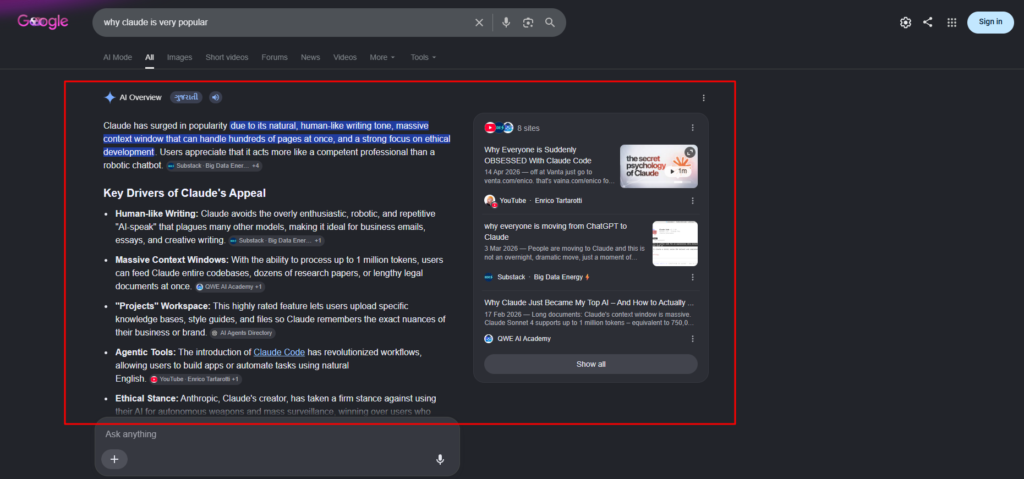
Think of it like asking a well-read friend a question instead of handing you a stack of books. Your friend still needs to have read something worth quoting. That “something” is your content, if you structure it the right way.
For business owners, this changes what a page one ranking actually means. You can rank well and still lose the click, because the searcher already has an answer. Getting cited inside the AI Overview itself is becoming just as important as the ranking underneath it.
How Google Chooses Content for AI Overviews
Google has published official guidance on this, and it is worth taking seriously because it comes straight from the source rather than from speculation.
According to Google’s Search Central documentation, AI Overviews and AI Mode are built on the same core ranking and quality systems that power regular Search, using techniques like retrieval-augmented generation to pull accurate, current information from the search index. In other words, this is not a separate game with separate rules. It is the same SEO fundamentals, applied to a new format.
That means Google is not asking which page is the longest, or which brand shouts the loudest. It is asking which page answers the question clearly enough that it can be reused without guessing.
A few things consistently show up across independent studies and Google’s own guidance:
- Pages that already rank in the top 10 for a query are far more likely to be cited in the AI Overview for that same query
- Clear, well-structured answers get pulled more often than pages that bury the answer under long introductions
- Fresh, verifiable information is favored, especially for topics that change often
7 Practical Steps for AI Overviews Optimization
Here is where I want to keep things simple. You do not need a complete content rewrite. You need to adjust how you present what you already know.
1. Answer the question first, explain second
Traditional blog writing often builds up to the answer. AI Overviews optimization flips that order.
If someone searches “why is my website slow,” open with the direct answer in the first sentence or two, then explain the reasoning afterward. Google’s systems look for content that resolves the searcher’s intent quickly, not content that makes them scroll to find it.
2. Structure your content so it can be extracted
AI systems are essentially skimming your page and trying to lift out the cleanest possible answer. Help them do that.
- Break paragraphs after 2 to 3 lines
- Use short, descriptive H2 and H3 headings
- Add a brief summary or TL;DR near the top of longer articles
- Use numbered steps for processes, and bullet points only where they genuinely aid readability
A page written as one long wall of text is much harder to summarize than one broken into clear, self-contained sections.
3. Build real E-E-A-T signals, not just a badge
Experience, expertise, authority, and trust are not checkboxes. They come from specifics.
Instead of writing “we have years of experience in SEO,” show a real example. Mention the actual result, the actual client type, or the actual mistake you fixed. AI Overviews and traditional rankings both favor content that reads like it came from someone who has actually done the work.
4. Add structured data through schema markup
Schema markup will not guarantee inclusion in an AI Overview, but it makes your content easier for machines to interpret correctly, and that supports visibility across AI search and standard zero-click search features alike.
Article, FAQ, and HowTo schema are good starting points for most business blogs. If you are on WordPress, plugins like RankMath or Yoast can add this without touching code.
5. Fix the technical SEO basics first
None of the above matters if Google cannot crawl or index your page properly. Before investing time in AI-specific tweaks, confirm the fundamentals:
- No blocked resources in robots.txt
- No indexing errors in Search Console
- Reasonable page speed and stable Core Web Vitals
- Content that renders correctly without depending heavily on JavaScript
These are not new AI Overviews requirements. They are the same technical SEO standards that have mattered for years, and Google’s own guidance confirms they still apply directly to generative search features.
6. Build topical authority instead of one-off posts
A single great article rarely earns consistent AI citations. A cluster of related, interlinked articles around one core topic does.
If you run an SEO agency, that might mean a pillar page on “technical SEO for small business,” supported by focused articles on crawl budget, internal linking, and Core Web Vitals, all linked to each other with natural anchor text.
7. Track AI visibility, not just rankings
Your usual rank tracker will not tell you when you are cited inside an AI Overview. Check Search Console’s Performance report, since AI Mode appearances are now included there, and do occasional manual searches for your target queries to see who gets cited and why.
Common Mistakes That Keep Good Content Out of AI Overviews
A few patterns show up again and again when I review sites that are struggling here.
Burying the answer under three paragraphs of backstory is one. Writing generic, unverifiable claims without examples is another. And treating AI Overviews optimization as a one-time project instead of an ongoing habit is probably the most common mistake of all.
Google’s own guidance is clear that manipulating AI responses at scale, such as publishing thin variations of the same page to chase every possible query, violates its content policies. That approach tends to backfire even in traditional rankings.
Frequently Asked Questions
Does ranking on page one guarantee an AI Overview citation?
No, but it helps significantly. Research and Google’s own systems show a strong correlation between top 10 rankings and AI Overview citations, so solid traditional SEO is still your foundation.
Do I need separate content for AI search and regular SEO?
Not usually. The same page can serve both, as long as it is well-structured, factually accurate, and clearly answers the query early.
Is schema markup required for AI Overviews?
It is not confirmed as a direct ranking factor, but it supports machine readability and helps across other zero-click search features, so it is worth doing regardless.
Bringing It All Together
AI Overviews optimization is not about outsmarting Google. It is about making your genuinely useful content easier to find, easier to trust, and easier to summarize correctly.
Start with the basics: fix your technical SEO, answer questions clearly and early, and back up your claims with real experience. The businesses that get cited in AI Overviews are usually the ones that were already doing SEO the right way.
If you would like help auditing your website for AI search visibility, feel free to explore more guides on SEO With Sachin, or reach out and I would be happy to take a look.